Geometry proof challenges students because it is not just about memorizing and providing quick answers, but about clear reasoning. When it comes to proof, you explain how a statement is true through the linked steps that follow a strict logic. It can be hard for many students because the process seems abstract. However, the method can be predictable. Yet the method becomes predictable once you understand how each postulate connects with the next. When you know how to do proofs in geometry, you display a solid understanding of working with the theorium. These strategies will help you in doing the proof easily. Here is what you need to know.
Start With the Given Information
Each proof comes with a given section. These facts are from your starting point, so read them with intention.
- Identify which segments or angles match.
- Locate any equal sides.
- Note any line relationships, such as parallel or perpendicular.
- Look for geometric words that carry definitions: midpoint, bisector, isosceles, perpendicular, radius.
A midpoint provides an equal segment. A bisector provides equal angles. Parallel lines create matching angle pairs. An isosceles triangle gives equal base angles.
Each phrase comes with a meaning. Use that meaning without wasting a moment. When you convert words into geometric facts, you create your first steps.
Understand What You Must Prove
This is crucial to do proofs in geometry. The proof statements tell you your destination. You should consider it your target. Let’s say the task is about proving two triangles are congruent. Your focus should be on gathering the three matching parts required for a congruence test. If the task asks you to show that two angles are congruent, aim to use definitions or triangle relationships that lead to that equality. Good proof writing, even in algebra, examines the destination before it starts. They ask about:
- What does this target require?
- Which facts support that requirement?
- Which definitions or theorems connect the given information to the target?
This analysis helps you create your path.
Draw a Clear Diagram
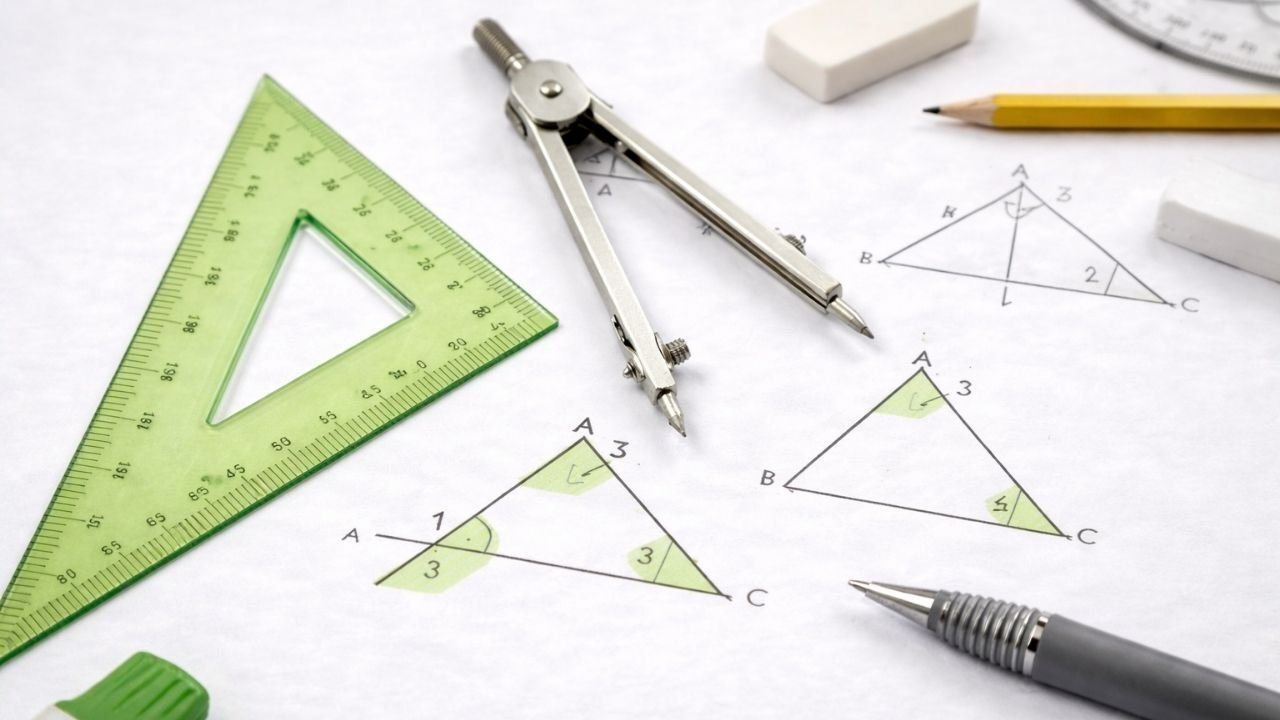
You cannot prove proofs in Geometry without a diagram, as it ends up creating confusion. Opt for creating figures, labeling every vertex, marking equal segments, marking bisected angles, and marking parallel lines. You can reduce the mental load with the visual structure. This also reveals a hidden relationship.
Many teachers encourage students to draw extra lines when needed. Students can break a complex figure into simpler pieces with the auxiliary lines. You may draw a median, extend a line, or form a triangle that wasn’t visible before. When you add a line, label it cleanly so your steps stay precise. Diagrams create clarity. Clarity supports better steps.
Use Definitions and Theorems as Tools
Geometry proofs rely on the toolbox. Once you understand the tools, the structure becomes predictable. Here are the most common tools to do proofs in Geometry.
Definitions
- Midpoint: Divides a segment into two equal parts
- Angle bisector: Divides an angle into two equal angles
- Perpendicular lines: Form right angles
- Radius: Equals all other radii of the same circle
- Isosceles triangle: Two equal sides, two equal base angles
Definitions turn words into exact facts. They often appear in the first few steps of a proof.
Angle Relationships
- Vertical angles are harmonious
- Linear pairs are supplemental
- Parallel lines create corresponding and alternate interior angles
- Perpendicular lines create four right angles
These mathematical relationships provide you with the angle equalities that support harmony.
Triangle Congruence Tests
- SSS (side-side-side)
- SAS (side-angle-side)
- ASA (angle-side-angle)
- AAS (angle-angle-side)
- HL (hypotenuse-leg, right triangles only)
Once you prove the congruence of two angles, you unlock matching parts of congruent triangles (CPCTC). This helps you finish many tasks.
Segment and Angle Facts
- Reflexive property helps when a segment or angle appears in both triangles.
- A median gives equal segments.
- A perpendicular bisector gives midpoints and right angles.
- A circle has equal radii.
When you know your tools, you choose steps with purpose. You no longer guess to write geometry proofs which direction to go.
Build the Proof Through Short, Connected Steps
A proof is considered successful when each statement depends on the previous one. Example sequence:
- C is the midpoint of AB.
- AC = CB by the definition of midpoint.
- CD ⟂ AB.
- ∠ACD and ∠BCD are right angles.
- ∠ACD = ∠BCD.
Each step flows from the previous one. The ideas remain close, and students can use this style to reduce confusion and avoid long reasoning leaps.
Your goal is to write steps that create a chain. The chain should move toward the task you must prove. If the target requires a harmonious triangle, then gather the required pieces. If the target requires angle equality, search for definitions and relationships that deliver those angles.
Use Congruent Triangles to Unlock New Facts
Congruent triangles offer strong conclusions. Once you prove two triangles are congruent. You gain new equal segments and angles through CPCTC.
For example:
- If you prove triangle ABC ≅ triangle EDF, you may claim AB = ED or ∠C = ∠F.
- These new facts often help you reach the final target.
Harmony sits at the center of different geometric proofs. Students who understand how to gather the right pieces. Like two sides and an included angle, or two angles and a side, complete proofs faster.
Stop When You Reach the Target
A proof should end exactly when the target statement becomes justified. Do not add extra steps. Do not go for filler lines. You should stop right when you reach for conclusion. This discipline keeps your work clean and precise.
Example of a Simple Geometry Proof
Given: AB = AC and AD bisects ∠A
Prove: ∠BAD = ∠DAC
Proof Summary:
AB = AC, so the triangle is isosceles. The bisector divides an angle into two equal angles. Since AD bisects ∠A, ∠BAD = ∠DAC by definition of angle bisector, this structure remains compact and clear.
How Geometry Proofs Work?
Proofs in geometry work through logical links. Every link is connected to the previous ones. When you place each idea near the next, the reasoning gets easy to follow. You don’t need to explain in long, complex sentences for proofs. You need to follow the right steps, clean labels, and accurate definitions. Students being successful in proving mostly focus on structure rather than intuition. They use the same process each time: understand the given facts, visualize the figure, identify the tools, create short steps, and connect each step to the goal.
Geometry works through a defined system. Systems like clarity. When you use theorems as they were designed, you avoid guesswork. You focus on a reliable framework that supports every conclusion.
FAQs About Proofs in Geometry
Let’s answer your questions about doing proofing in geometry.
How do you start a geometry proof?
Starting with the given information. Turn every phrase into a definite geometric fact using definitions. Then draw a diagram and label each relationship.
Why do geometry proofs feel difficult?
Students find proof difficult due to precise reasoning. Students should explain every step with definitions and theorems instead of relying on intuition. With a stable process, proofs become predictable.
What are the most common theorems used in geometry proofs?
Students use angle relationships, triangle congruence rules (SSS, SAS, ASA, AAS, HL), and properties of parallel lines. Definitions such as midpoint and bisector appear often.
How do I know which triangle congruence test to choose?
Opt for the test that matches the facts that you can prove. If you know three sides, choose SSS. If you understand two sides and an included angle, choose SAS. If you know two angles and a side, choose ASA or AAS.
Do I always need to prove triangles congruent?
No. Some proofs in geometry focus on angle relationships or segment properties. Congruence helps often, but not always.
What makes a geometry proof strong?
Short steps, clear logic, accurate definitions, and a direct path toward the target make a proof strong. Students should avoid long explanations and rely on precise properties.
Why do teachers emphasize diagrams in proofs?
A diagram prevents confusion and shows hidden relationships. They help students in keeping track of equal angles, matching sides, and parallel lines.

Bottom Line
Geometry proofs help students to reason through structure. Every step is connected to the previous one. When you keep related ideas close and rely on clear definitions, the proof becomes simple. You always start with the provided facts and visualize the diagram. Work with exact theorems and build short steps that move toward the target. This method remains effective in classrooms, standardized tests, and advanced math courses.
In strong preparatory programs, like Ivy Tp, teachers often guide students to treat proofs as sequences of short, dependent ideas. Instead of long, complex arguments, the proof remains short and direct. The reasoning is simple, and the structure is stable. Writing and reading a proof becomes easier when ideas are close to each other.