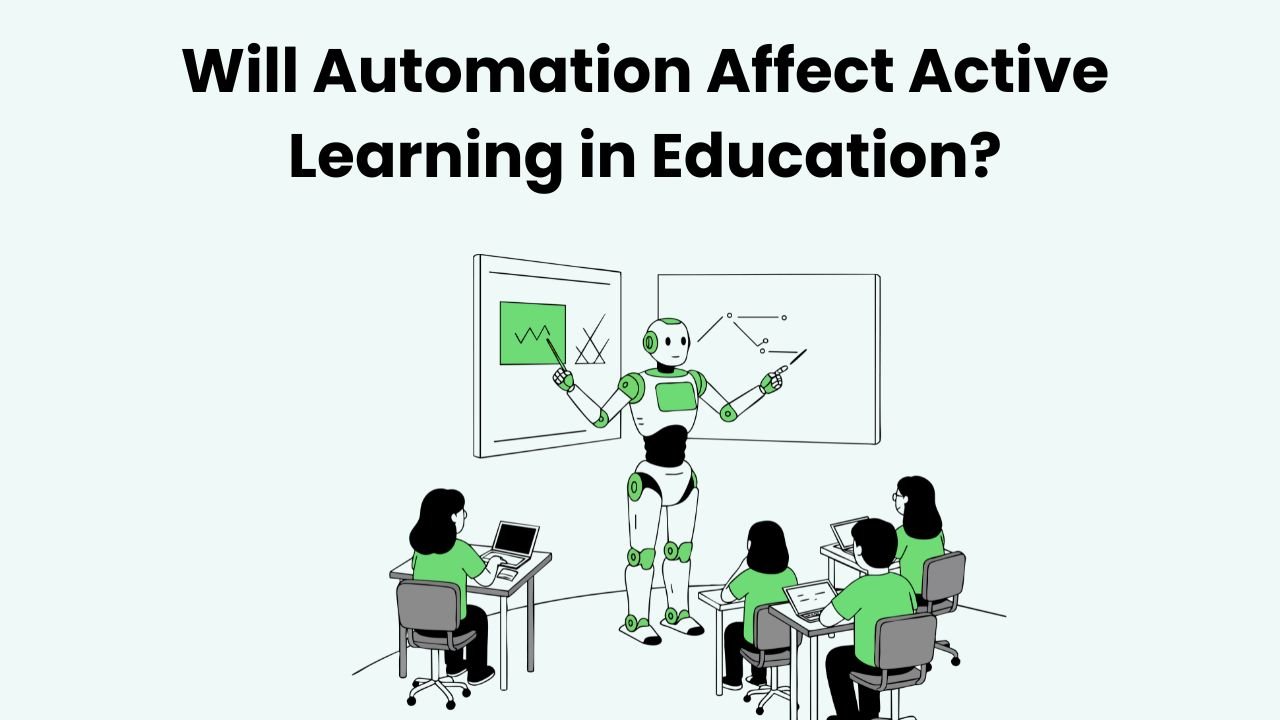
AI has become not only a buzzword but also an integral part of different aspects of life. Education is no exception. In fact, AI-powered automation has changed education a lot. AI is helping students from generating essays and summaries to providing instant answers to research questions. It has become their tailored study partner with uninterrupted access to the knowledge. Sounds amazing on the surface, as students can complete assignments faster and information is easier to access. But it also possesses some serious challenges. Students now are largely relying on AI, skipping the cognitive processes that require reflective learning.

Skills such as analyzing the source, assessing the information, and evaluating the evidence have been compromised. Automation surely is efficient, but it doesn’t understand everything. Here is food for thought.
What Active Learning Means in Education
Critical learning in education is more than memorization or completing assignments. It focuses on:
- Critical thinking where students questioning the assumptions and drawing connections between ideas.
- Active engagement where students have to interact with the material, experiment with the data by applying knowledge.
- Reflective reasoning evaluates your own thought process and ideas to clarify understanding.
- Independent research by checking and finding the resources, weighing credibility, and synthesizing information.
When students don’t possess or have an idea about these, then the learning becomes shallow. Students may produce outputs with automation in education that appear complete, but the underlying understanding remains weak.
How Automation Helps in Learning?
AI-assisted learning can help individuals learn in different ways:
-
AI As Research Companion:
One can quickly summarize a huge amount of information, highlight the key concepts, and suggest references. This makes the research a more convenient part of learning.
-
Writing assistance
AI can be customized for grammar corrections, style suggestions, and as a content structuring tool. Students can focus on ideas rather than mechanics.
-
Personalized learning
Because AI is now accessible to everyone so one can get tailored content according to their understanding, effortlessly, which helps them review concepts they find challenging.
-
Idea generation
Using AI and automation for brainstorming and outlining can improve student research skills and approach topics from multiple angles.
These are the potential benefits of AI in learning. If students know how to use it intentionally instead of abusing then AI can be beneficial for students.
The Risk Of Automation as a Shortcut
AI and automation can become a danger in learning when they become a replacement rather than a support. The problem arises when:
Superficial understanding:
Topic summaries or essay generation may help the students in saving time, but they kill the purpose of education. Students may rely on AI to generate information about a topic without critically engaging with the material. Instead of learning about the actual topic, they will have the outline, which is a serious problem in learning.
Reduced research skills:
Searching is the critical part of education. Students can obtain an answer with little effort, but this skips the source evaluation and filtration. This reduces the analytical thinking skill.
Erosion of problem-solving abilities:
Exams like the LSAT focus on the problem-solving skills of students rather than general content memorization. But students with automated solutions will have no clue about the practice of reasoning and logic.
Overconfidence:
When students have convenient access to answers and information with AI, it creates the illusion of mastery without genuine comprehension.
When automation is considered as the brain and a substitute for cognitive effort, it damages the purpose of learning.
How To Balance Automation and In-depth Understanding?
Automation can be both a blessing and a curse for higher-order thinking skills. Students and educators must adopt a balanced approach. Effective strategies include:
Critical engagement with AI outputs:
AI-generated content should be a starting point. Students should analyze the output, question, and refine ideas.
Meta-cognition exercises:
Focus on explaining how the conclusions were made. Don’t just rely on the generic conclusions by AI.
Blended assignments:
While using AI for assignments, mix the AI-assisted tasks with the hands-on research, experimentation, and discussion.
Structured scaffolding:
Guide students to use AI as a tool, not a crutch. Encourage note-taking, source comparison, and synthesis before using AI outputs.
Assessment redesign:
Focus on grading the student’s content on reasoning and thought process rather than only the final product.
Through deliberate practice, automation can enhance inquiry-based learning rather than diminish it.
Future of Active Learning In An Automated World
The debate of AI killing understanding and learning will not end on a negative note unless one is not thinking one-dimensionally. Student research skills are not finished with AI, but are evolving. Students who learn to take advantage of AI thoughtfully can work smartly, achieve higher levels of understanding than previous generations. AI can free cognitive resources for analysis, creativity, and application, allowing deeper engagement with complex concepts.
The solution lies in the intentional usage of AI. The integration of AI thoughtfully complements human cognition rather than replacing it. This is how students can retain control over their intellectual growth while benefiting from AI’s efficiency.

Automation Killing Focused Learning FAQs
Does using AI mean students are lazy?
Only when AI is the sole part of the education from the starting point for analysis and reflection, when effort is replaced with AI, do the students get lazier.
How can teachers prevent over-reliance on AI?
Educators can design assignments that require critical evaluation of AI outputs, incorporate reflection, and prioritize reasoning over content production.
Is focused learning still relevant in the AI era?
Yes. Focused learning requires and develops the cognitive skills, critical thinking, problem-solving, and creativity that AI cannot replicate.
Can AI improve higher-order learning?
Yes. When used as an AI-powered study companion for research, brainstorming, and concept review, it helps students focus on better thinking and synthesis.
Bottom Line
Automation is neither a killer of higher-order learning nor entirely beneficial. The impact of AI-assisted learning depends on how students and educators use it. AI-enabled writing assistants can provide quick access to a wide array of knowledge, reducing repetitive effort with personalized guidance. However, the problem arises when students rely on assisted learning too much without learning the basic skills of learning. Without critical engagement and reflection, it risks rotting the very skills inquiry-based learning builds.
When students use AI the right way as a helpful tool, not a shortcut, they learn faster, smarter, and more flexibly than ever. Paired with intentional practice, automation actually boosts learning instead of replacing it, just like Ivy Learning and Test Prep help students prepare effectively.