The HSPT rewards the structural awareness as much as academic knowledge. Every section focuses on a distinct skill set that uses strict limits and follows predictable question patterns. Students who understand the HSPT test structure manage time better, reduce anxiety, and score more consistently. Here is everything you need to know about the test structure of HSPT.
Overview of the HSPT Exam Format
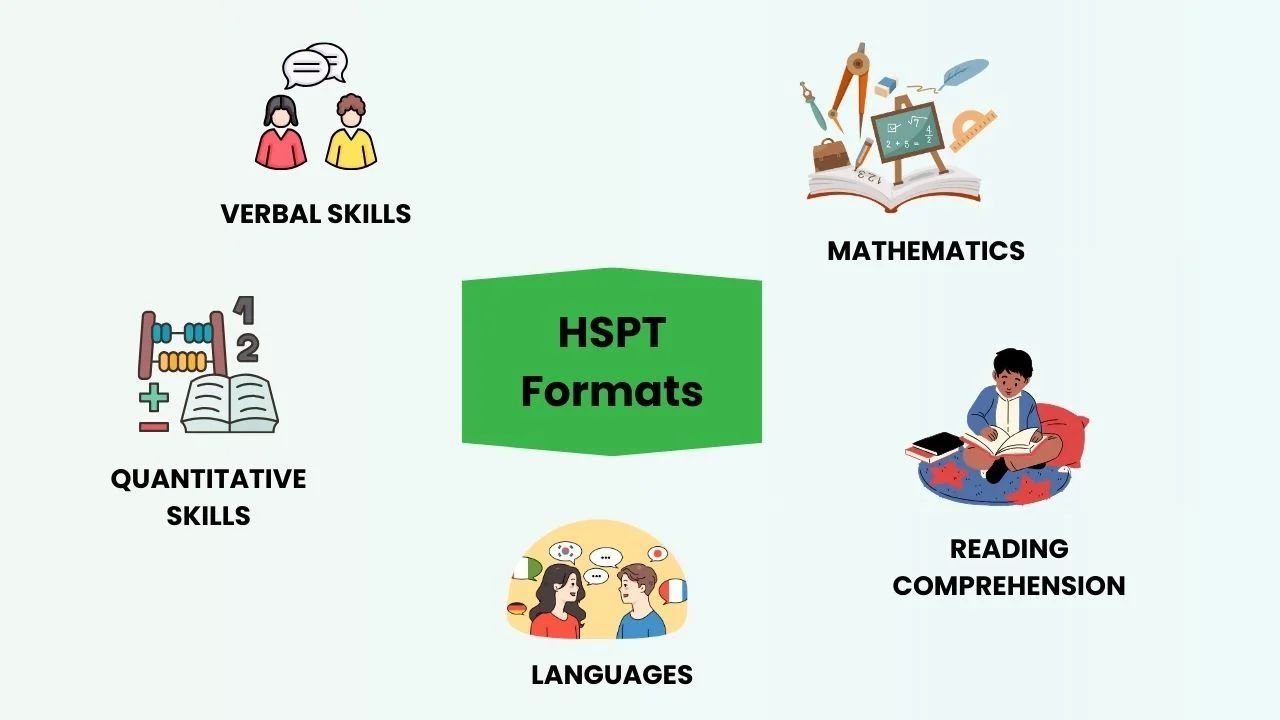
The High School Placement Test is used to assess the current 8th grader’s skills for placement into 9th grade. Catholic and private high schools across the United States for admissions and placement decisions. It tests verbal skills, quantitative skills, reading comprehension, mathematics, and language.
HSPT Structural Fact
Feature | Details |
Test Type | Multiple choice |
Total Time | Approximately 2.5 hours |
Question Count | Around 298 questions |
Delivery Method | Paper-based |
Scoring Method | Standard scores and percentile rankings |
Test Date | Determined by individual schools |
Schools may add or remove optional sections, but the core structure remains consistent nationwide.
Core HSPT Sections Explained
Here is the breakdown of the HSPT structure:
1. Verbal Skills Section
This section has a total of 16 minutes, where they have to complete 60 minutes. The focus of this section is vocabulary and verbal reasoning
This section measures how well students understand and apply language.
Question Types
- Synonyms
- Antonyms
- Analogies
- Logic-based word relationships
What This Section Tests
- Vocabulary depth
- Word relationships
- Conceptual reasoning
- Speed of recognition
Students usually underestimate this section. Even stronger students may struggle if they have a week of vocabulary exposure that remains narrow. Preparation requires focusing on word families and contextual meaning, not memorization alone.
2. Quantitative Skills Section
The quantitative skills section features 52 questions with a 30-minute time limit. The focus is on the mathematical reasoning. This section tests how students think with numbers, not how well they follow formulas.
Common Topics
- Number patterns
- Sequences
- Logical reasoning
- Data interpretation
- Non-calculator problem solving
Unlike the mathematics section, this part focuses on strategy and logic over computation. Students should identify the connection quickly and select an efficient solution path.
3. Reading Comprehension Section
This section focuses on understanding the written passages with 62 questions, and the time limit is 25 minutes. Passages vary in length and subject, including fiction, nonfiction, science, and humanities.
Skills Assessed
- Main idea identification
- Supporting detail recognition
- Inference
- Tone and purpose
- Vocabulary in context
The HSPT prefers the skills of active reading and not just speed. Students who pause to anchor each paragraph perform better than those who rush through passages.
4. Mathematics Section
This 45-minute section features 64 questions that assess curriculum-based math knowledge. This section aligns closely with middle school math standards.
Topics Covered
- Arithmetic operations
- Fractions and decimals
- Ratios and percentages
- Algebraic expressions
- Geometry basics
- Word problems
This section requires accuracy. Students take advantage of a clear setup and a declined pacing. Unlike Quantitative Skills, this section favors methodical problem solving.
5. Language Skills Section
This section focuses on grammatical and writing skills with 20 questions and a time limit of 60 minutes. This section evaluates how well students understand written English.
Tested Areas
- Sentence structure
- Grammar rules
- Usage
- Capitalization
- Punctuation
- Paragraph organization
Students lose points here because of rushed reading. Every question contains clues. The strongest performers read each sentence as a unit, not as fragments.
Optional HSPT Sections
Some schools also offer additional sections for placement purposes.
Science
- Focuses on basic scientific concepts
- Emphasizes reasoning over memorization
Catholic Religion
- Tests foundational religious knowledge
- Used primarily in Catholic school placement
While these sections don’t affect admissions, students should confirm requirements with their target schools.
How the HSPT Is Scored?
The HSPT doesn’t feature a single composite score.
HSPT Score Types
- Standard Scores: Used for comparison
- Percentile Ranks: Show relative performance
- Stanines: Broad performance categories
Schools analyze the scores differently. Some focus on section strength, while others focus on overall balance.
How Schools Use HSPT Results?
Admissions committees rely on HSPT scores to:
- Understand the academic readiness
- Place students in honors or standard tracks
- Understand the learning support requirements
The score rarely stands alone. Schools review the transcript, interviews, and recommendations alongside HSPT performance.
How Students Should Prepare Based on the HSPT Structure?
Preparation should align with the HSPT structure and functions.
- Practice the full sections under the limited time conditions.
- Focus on building vocabulary by improving and expanding the reading rather than lists.
- Strengthen reasoning before drilling math
- Review grammar rules with applied examples
Students with guided preparation and structured programs, such as Ivy Test Prep, prepare with confidence. Professional programs emphasize the diagnostic insights and section-based mastery rather than volume practice. This approach aligns closely with how the HSPT measures readiness.

HSPT Test Structure FAQs
Let’s answer your questions about the HSPT test format.
How long is the HSPT test?
The HSPT takes around 2.5 hours, including all basic sections.
How many sections are on the HSPT?
The HSPT includes five core sections: Verbal Skills, Quantitative Skills, Reading, Mathematics, and Language. Optional sections may appear.
Is the HSPT multiple choice?
Yes. All HSPT questions are multiple choice.
Does the HSPT allow calculators?
No. Students should complete the entire math section without calculators.
Are all HSPT sections equally important?
Importance varies by school. Most schools assess section-level performance alongside overall scores.
Can students retake the HSPT?
Policies vary by school. Many schools allow one official administration.
Bottom Line
The HSPT is not just about guesswork or cramming. It rewards students with an understanding of the HSPT structure and prepares them with intention. Each section measures a different academic muscle, under precise time limits, with little room for recovery from early mistakes. When students learn about the HSPT format, preparation becomes focused. Students face less anxiety and perform stably.
Understanding the test structure turns preparation from stress into strategy, and that shift often makes the difference on test day.