You may have heard that the SSAT is challenging even for students who perform well. We will learn whether it is true or just a myth. We will evaluate SSAT difficulty by considering different aspects, including question types, test sections, allocated time, and other essentials.
Understanding SSAT
The SSAT test is not based on classroom knowledge. It assesses students’ vocabulary, problem-solving skills, reading comprehension, and ability to answer questions. Your academic strengths and familiarity with the test format make the SSAT easy.
Some students may be unfamiliar with vocabulary, while others find the math questions or reading passages more demanding. Understanding what makes the SSAT difficult helps students prepare more effectively and approach test day with high confidence.
The SSAT assesses students’ verbal, reading comprehension, and quantitative reasoning skills. Understanding what is on the SSAT can help students understand what to expect and why preparation matters.

What Makes the SSAT Hard?
SSAT can feel hard to students for various reasons, no matter how good an academic background they have. Below are some possible causes that make the test challenging for test-takers.
1. Challenging Vocabulary
The verbal section tests the students’ understanding of synonyms and analogies. Some words may be unfamiliar to them, and their meanings and relationships need to be understood rather than relying on memorizing. They can find it hard to do.
2. Time Pressure
There is a fixed time for test participants to complete each section. In this allocated period, they have to read questions carefully, solve problems, and answer without spending much time on a single question. Poor time management can make even easy questions harder, particularly for those who do not practice at the actual official pace.
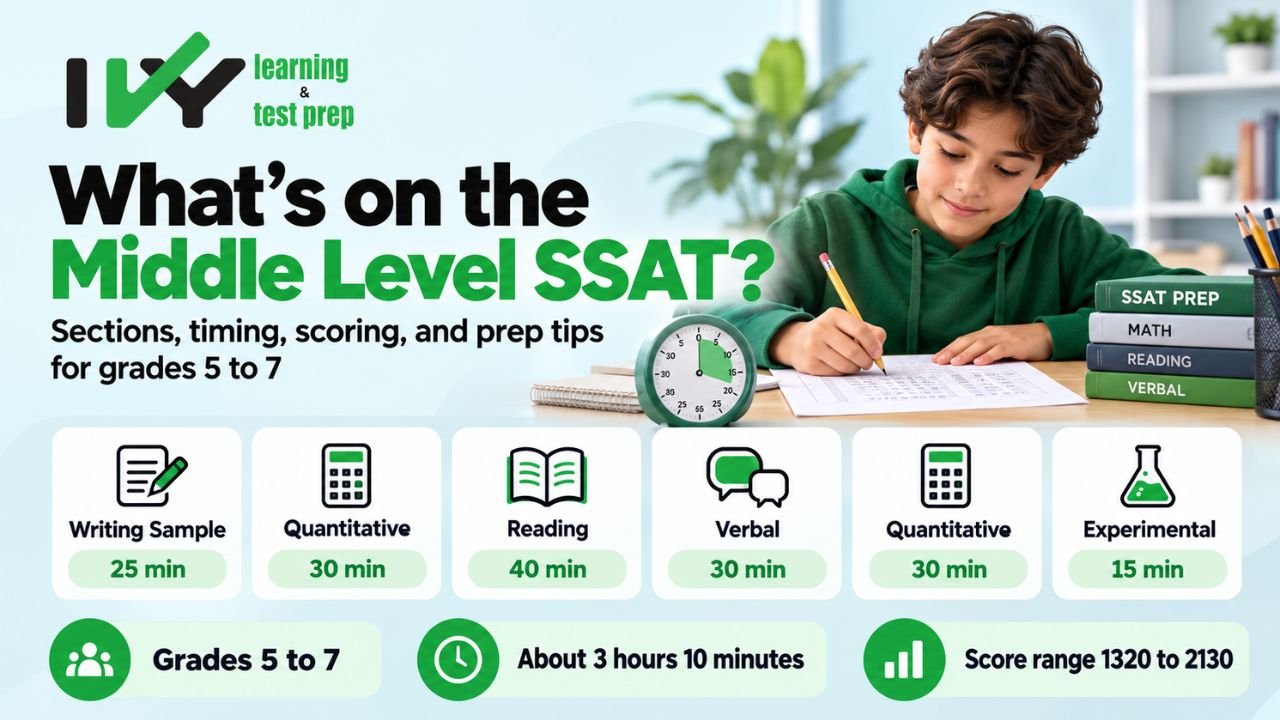
Students must manage their time carefully to complete each section without rushing through questions. Knowing how long the SSAT test is and how much time is available for each section can help students plan their practice sessions more effectively.
3. Reading Comprehension
The Reading section expects students to understand passages, identify main ideas, and interpret information. It may sound easy to you, but some questions can ask you to conclude the text, which can feel challenging. That is because the answer is not stated directly in the paragraphs.
4. Math Problems
If you are taking middle- and upper-level tests, there are two Quantitative sections in the SSAT. Kids at the elementary level have to take only one section. This part’s purpose is to test your mathematical concepts and problem-solving skills. The questions’ answers usually consist of several steps or need to apply familiar concepts. Usually, the questions are moderate but asked in unfamiliar ways.
5. The Wrong-Answer Penalty
In Middle and Upper Level SSAT, a quarter of a point is deducted for an incorrect answer. This means you must know when a question should be answered and when to leave it blank. It is like another decision-making duty during the test. This penalty does not apply to the Elementary Level SSAT.
Is the SSAT Harder Than Other Admission Tests?
No. Neither the SSAT nor the other admission tests are harder, such as the Independent School Entrance Exam (ISEE). There is no test considered universally challenging. Test-takers feel the SSAT’s difficulty according to their skills in verbal reasoning, math, and reading. Their familiarity with the test format also matters.
The best way to compare the difficulty level of tests is to look at their differences. The SSAT includes analogy questions in its Verbal section, whereas the ISEE uses sentence completion questions. Then, see the scoring rules of the exams. For example, if we take the SSAT or ISEE, they both differ in scoring method. The Middle and Upper Level SSAT deducts a quarter of a point for each incorrect answer. On the other hand, students are not penalized in ISEE for incorrect answers.
How Hard is the SSAT Scoring System?
Since the SSAT penalizes a quarter of a point for a wrong answer, many students find this a scary part of scoring. Let’s learn about the other aspects of scoring as well. Keep in mind that scoring rules depend on which SSAT level you take. In the upper and middle SSAT, you earn a point for each correct answer. However, you receive no points for blank questions.
On the other hand, the Elementary Level SSAT does not deduct one-quarter of a point for incorrect answers.
Ivy Learning does not recommend leaving every uncertain question blank. This may not be a good strategy. If you approach questions where you can eliminate some answer choices, make an educated guess. It would be worthwhile and can increase the chance of a correct answer.
Knowing about these rules before the test helps you make better decisions and avoid losing points unnecessarily.
SSAT Scoring Stages
Although the SSAT scoring system is straightforward, predicting your final score can be complicated; even the calculators can only provide estimates.
Once the checker determines your raw scores, they will be converted into a scaled score. The scoring range depends on the student’s SSAT level. This is because each of the three sections, Verbal, Quantitative, and Reading, has its own score range for different graders.
- Elementary Level: 300–600 per section, with a total score of 900–1800.
- Middle Level: 440–710 per section, with a total score of 1320–2130.
- Upper Level: 500–800 per section, with a total score of 1500–2400.
You may not know that the SSAT also adjusts scaled scores to account for small differences in difficulty between test forms. It is called equating, which helps scores be comparable across different versions of the test. This is why the same number of correct answers does not always produce the exact same scaled score for different test forms.
SSAT test-takers must know about these essentials to interpret results more accurately. This scoring method shows that you cannot track your progress simply by counting correct answers. It is far better to assess performance and identify areas that need more work through official practice tests.
Raw scores are converted into scaled scores, and the scoring ranges differ by SSAT level. Understanding how SSAT scores are calculated for all levels can help students interpret their results and track their preparation more accurately.
Preparation Tips for a Difficult SSAT
Instead of stressing, you should be building skills and becoming familiar with the test format, question types, and scoring structure. Smart preparation starts with understanding where you currently stand.
1. Start With a Practice Test
Before starting preparation, you must take the official test. Its results help you identify which topics you already understand and which need more attention. For this purpose, the official SSAT website also offers a free Mini-Practice Test for Middle and Upper Level students.
2. Focus on Your Weak Areas
Reviewing the results of your practice test determines where you should spend more time (on the topics you find difficult). For example, if you struggle with verbal questions, you need better vocabulary and an understanding of word relationships. If math is your weak area, review the relevant concepts and solve different types of problems.
3. Practice With Official SSAT Materials
During your practice, use the lengthy practice tests that are designed for your SSAT level. The official stuff includes full-length practice tests, answer explanations, and scoring guidance. These resources play an integral role in building awareness of test questions and formats and assessing your progress.
Full-length practice tests help students become familiar with question formats, section timing, and test-day expectations. Using SSAT practice tests and preparation tips can also help students identify weak areas and measure their progress.

4. Review Your Mistakes
Do not only check how many answers you got right. Instead, your approach should be to look at the questions you missed and figure out why you answered incorrectly. You may have misunderstood the question, forgotten a concept, or marked an answer without solid assurance. Learning from mistakes slowly reduces the chances of repeating them, especially in the actual SSAT.
5. Practice Under Test Conditions
Time management is also important to perform well in the SSAT. To match your speed with the time allowed for each section, solid preparation is a must. Set an allocated time limit and follow the test’s rules whenever you take a practice test. This is an effective way to become familiar with the testing experience and recognize when you need to improve your approach. Afterward, always review your answers to identify your weak points.
6. Follow a Consistent Study Schedule
Fix a daily timeframe to prep for the SSAT instead of trying to learn everything shortly before test day. Divide study sessions among subjects being tested, review previous mistakes, and take practice tests as you progress. Adjusting your schedule based on your results contributes to useful learning. It also saves students the effort of going in the wrong direction.
Once students establish a study schedule, they should plan their preparation around their intended test date. Checking SSAT test dates and registration deadlines helps families organize practice and complete registration on time.
SSAT Difficulty FAQs
Below are the answers to some of the main questions students often ask:
Is the SSAT harder in higher grades?
Yes, the SSAT becomes more competitive as you move to upper grades. The vocabulary and questions scale to match your grade level. This means each SSAT level is designed for a different grade range. The Upper Level SSAT is intended for students in grades 8–11. The Middle Level is for grades 5–7, and the Elementary Level is for grades 3–4.
Does the SSAT writing sample affect your score?
No. The writing sample is not included in the SSAT’s numerical score. Only the schools that receive your score report receive the writing sample. They inspect this for students’ admissions evaluation.
Is the SSAT experimental section included in the final score?
The experimental section does not contribute to your test score like the writing part. It is used to test new questions for future SSAT exams. Although it is an unscored section, you should still properly prepare for it and complete it effectively according to the test instructions.
Can you take the SSAT more than once?
Yes, students can take the SSAT multiple times if they fulfill the testing policies. Check the official SSAT Candidate Handbook for the latest retesting rules and scheduling requirements.
Do private schools require a specific SSAT score?
No, there is no single score every private school requires. Each of them has its own admissions criteria and considers SSAT results within the broader application. Therefore, check the requirements of the school you’re applying to rather than relying on one universal target score.
Wrap Up
Today’s article concludes that the SSAT can feel challenging, but don’t let it overwhelm you. Make your goal not to master everything overnight but to properly understand concepts, practice what the test expects, and prepare accordingly.
The SSAT preparation tips include staying consistent, tracking your progress, and giving yourself enough time to improve. A clear plan guides you to approach test day with greater confidence.