What Is a Good SSAT Score for Private Schools?
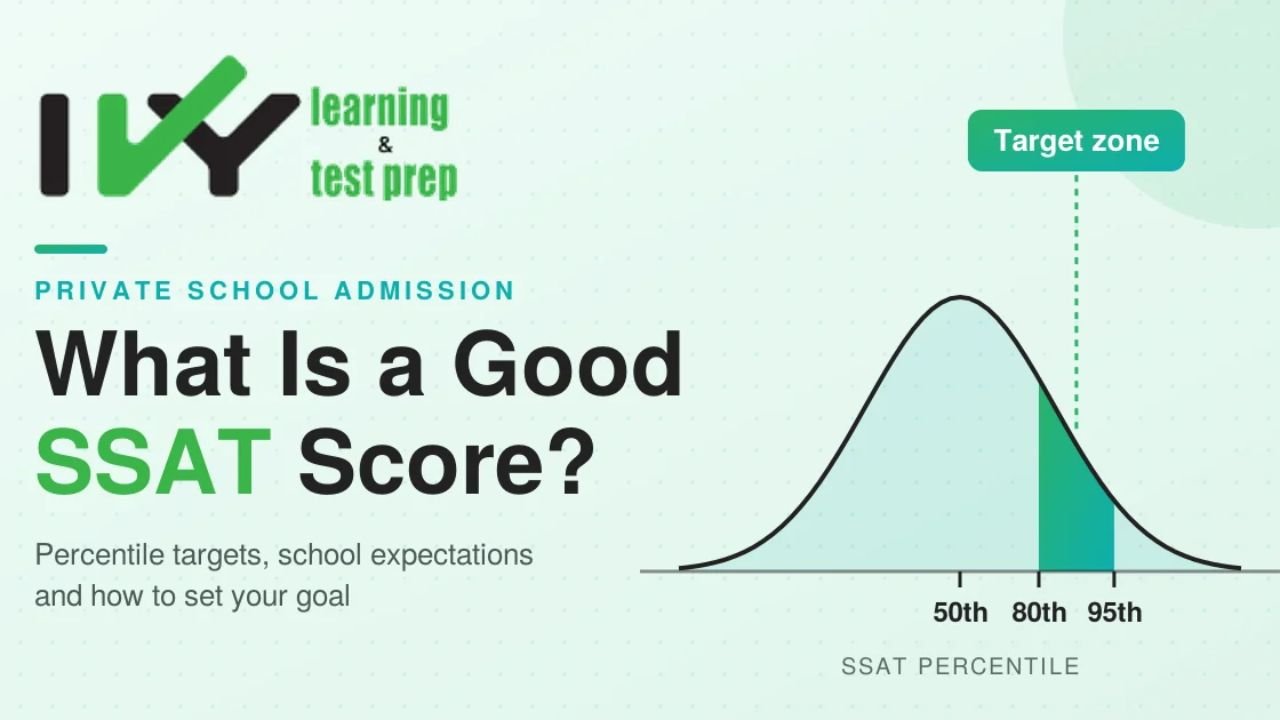
A good SSAT percentile depends on the schools you plan to apply to. The following ranges offer general guidance for setting a target, but they are not official admission cutoffs. Some schools may consider students with lower percentiles, while highly selective schools may expect stronger results. To see how top scores compare across levels, read our guide to the best SSAT scores.
Below are the ranges that you can use as general guidelines instead of fixed admission requirements.
| SSAT percentile | General interpretation |
|---|---|
| Around the 50th | May be sufficient for some schools; check individual policies. |
| 60th–80th | May be competitive at some schools, depending on the applicant pool. |
| 80th–95th | A useful target range to investigate for selective schools. |
| Above the 95th | A strong relative performance, but not a guarantee of admission. |
These ranges are general guidance, not official school cutoffs. A student’s competitiveness depends on the school’s admissions criteria, grade level, applicant pool, and overall application.
A student’s SSAT percentile helps them understand how their performance compares with that of other test-takers in the same grade. If you are applying from middle school, see what is a good SSAT score for an 8th grader. Let’s understand this with an example. Suppose you got the 70th percentile. This means you scored as well as or better than approximately 70% of students in the comparison group. So, don’t think you answered 70% of the questions correctly.
A Good SSAT Score Does Not Guarantee Admission
You may have met your target school’s SSAT score expectations, but keep in mind that other records are also considered. These usually include teacher recommendations, essays, interviews, and extracurricular activities.
Your goal should be building an impressive and compelling overall application, not focusing on your SSAT score alone. Research your target schools’ admission criteria to understand what they expect and where you may need to improve.
What SSAT Scores Do Selective Private Schools Expect?
Students applying to highly selective private schools may benefit from targeting the 85th–95th percentile or higher. However, these percentiles are general preparation targets, not universal admission requirements. Each school sets its own testing policies and evaluates applicants differently.
SSAT score expectations vary by school. For example, Cate School states that competitive applicants to grades 9 and 10 typically score around the 80th percentile on the Upper Level SSAT. However, the school has no minimum score requirement and evaluates applicants holistically, considering test results alongside other application materials.
A 2026 comparison by Compass Education Group shows that applicants to some selective schools have high average SSAT percentiles. For example, Phillips Academy Andover reports an average of the 93rd percentile, Phillips Exeter Academy 94th, and Horace Mann School 92nd. Note that these are average figures, not minimum score requirements or guarantees of admission.
How Should You Set Your SSAT Score Goal?
Start by identifying the SSAT level required for your target grade and checking each school’s current testing policy. Our overview of what is on the SSAT explains each level. If a school publishes typical score ranges or percentile guidance, use that information as a reference rather than a guaranteed cutoff.
Next, take a diagnostic SSAT practice test to understand your current performance. Compare your results with your target, identify your weakest sections, and build a preparation plan around the areas that need the most improvement. Review your progress with timed practice tests and adjust your target when you have reliable results.
If a school does not publish SSAT score expectations, contact its admissions office instead of assuming a particular percentile is required.
Can You Get Into a Private School With an Average SSAT Score?
Yes, applicants can successfully gain admission to a private school with an average SSAT score. Some private schools have no minimum SSAT score and evaluate every part of the application instead of relying solely on test results.
What If Your SSAT Score Is Below Your Target?
First of all, check the admission policy of each school on your list. Some of them may make testing optional or accept alternative tests. If your target school requires the SSAT and your score is lower than expected, focus on presenting a strong academic record. Completing the rest of your application carefully may strengthen your overall application.
Key Note: Remember that an average SSAT score doesn’t mean the admissions committee will reject your application, just as a high score doesn’t guarantee admission. Overall admission possibilities depend on the school’s requirements and how it evaluates your overall application.
How Is Your SSAT Score Evaluated?
A school’s admissions committee evaluates your SSAT score through your overall and section scores, percentile ranks, and academic performance. However, it is up to each school to decide how much weight to give your results during the admission process.

Section Scores
The student score report also provides individual section scores for the Verbal, Quantitative, and Reading parts, along with percentile ranks. These results help you identify your stronger areas and the skills you still need to improve. Our SSAT Verbal section tips can help if that is your weaker area. Schools can use the information to assess your academic readiness, but their evaluation methods vary.
Scaled Scores
SSAT scaled scores are derived from raw scores using a process that accounts for differences in test-form difficulty. Each scored section has its own scaled score, and the total score combines the Verbal, Quantitative, and Reading section scores. Score ranges vary by SSAT level, so check the official SSAT scoring guide for the applicable level.
- Elementary Level: 300–600 per section
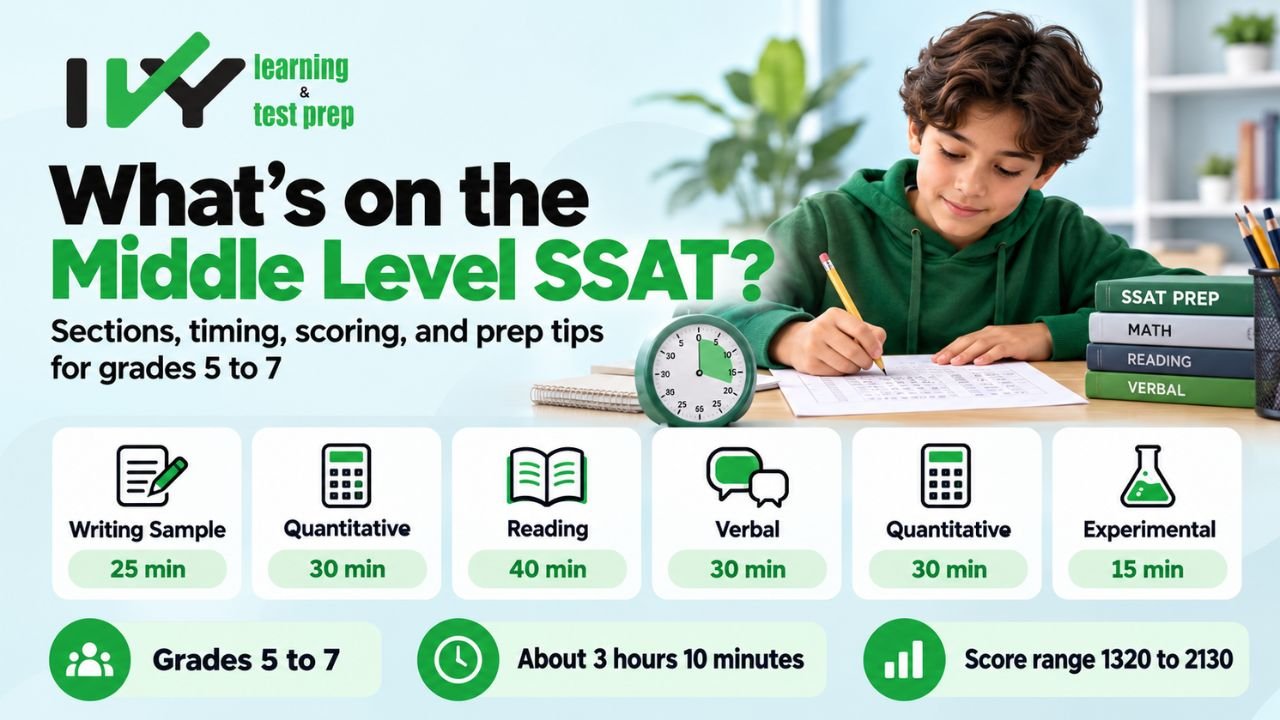
- Middle Level: 440–710 per section
- Upper Level: 500–800 per section
At the Elementary Level, incorrect answers do not incur a penalty. At the Middle and Upper Levels, correct answers earn one point, incorrect answers deduct one-quarter point, and unanswered questions receive no points. Check the official SSAT scoring guidance for the current rules applicable to your test level.
Percentile Ranks
Percentile ranks show how your performance compares with other students who take the SSAT. They indicate the percentage of students you scored as well as or better than. For example, the 80th percentile means you scored as well as or better than approximately 80% of test-takers. It does not mean you answered 80% of the questions correctly.
Overall Application
An SSAT score is just one part of the admission application. Schools review everything, including grades, recommendations, essays, and other application materials. Always check the school’s admission policy to understand how it uses test results.
How Can You Improve Your SSAT Score?
There is no universal threshold that can tell which SSAT score is good. Once you set a specific SSAT score goal, use the tips below to achieve it.

- Build Your Vocabulary: You need an extensive vocabulary to perform well in the SSAT Verbal section. Prepare for synonyms and analogies by learning unfamiliar words, reviewing their meanings, and studying common roots and prefixes.
- Review Math Concepts: Strengthen your understanding of mathematical concepts that you find difficult and solve word problems regularly to improve your performance in the Quantitative section.
- Practice Reading Comprehension: You must be an expert in identifying main ideas, supporting details, inferences, and the author’s purpose in reading passages.
- Review Your Mistakes: During practice, learn from your mistakes. Think about why you chose an incorrect answer and practice similar questions. This way, the chances of repeating them are reduced. See our list of common SSAT mistakes to avoid.
- Practice Under Timed Conditions: Improve your time management by completing timed practice sections. This not only speeds you up but also makes you familiar with the test format. Learn how long the SSAT is so you can pace yourself.
- Know the Scoring Rules: In Middle and Upper Level SSAT tests, an incorrect answer deducts one-quarter point. So, use the elimination technique to first exclude incorrect options and then make informed guesses instead of guessing randomly.
- Use Official Practice Materials: Prepare with official SSAT questions and tests to become familiar with the question types and assess your progress.
Frequently Asked Questions About Good SSAT Scores
Below are the answers to some of the common questions you may have:
Can You Retake the SSAT to Improve Your Score?
Yes, you can take the SSAT multiple times. Many students reach their target score on their second attempt. Check your target schools’ policies and the upcoming SSAT test dates before scheduling another attempt, because some schools may have specific score-submission requirements.
Does a Good SSAT Score Guarantee Admission to a Private School?
No, an SSAT score alone does not guarantee school admission. The admissions committee also considers other factors, including academic records, teacher recommendations, extracurricular activities, essays, and interviews. This means a strong score is one part of the admission application. You have to strengthen your overall academic profile and fit with the school’s expectations.
How Long Does It Take to Receive SSAT Scores?
Paper-based SSAT scores take approximately 2 weeks. SSAT at Home scores are released on the Wednesday of the respective week, usually within 3 to 4 business days. Prometric scores are typically released on the Wednesday following the end of the Sunday-to-Saturday testing period. Check the official SSAT score release schedule for the latest details.
Does the SSAT Writing Sample Affect Your Score?
No, the SSAT writing sample is an unscored section. At the time of registration, applicants choose the schools they want to send SSAT scores to, and students’ writing responses are also sent to these schools. The purpose is to help them evaluate your written expression and ability to organize ideas.
Can You Prepare for the SSAT Without a Tutor?
Yes, you can prepare for the SSAT effectively without a tutor. First, familiarize yourself with the test format and the time limits for each section and the entire exam. Before starting your preparation, take a diagnostic test to identify your strengths and weaker areas. During your preparation, use official practice materials, take full-length, timed practice tests, and follow a consistent study schedule. These tips on balancing schoolwork with SSAT prep can help you plan.
Conclusion
Students preparing for the SSAT should determine what qualifies as a good SSAT score based on their target schools. There is no universal score range that applies to every school. Set a goal, then start preparing for the SSAT.
Consistent effort and a clear study plan lead to confidence and steady progress toward your desired SSAT score. We recommend that you start by identifying your weak areas, prepare with official test materials, and review your mistakes after every practice test. Give yourself enough time to build confidence before test day. Remember that steady progress matters more than trying to master everything at once. If you want structured support, explore our SSAT and ISEE prep programs.