The upper-level SSAT is designed for students in grades 8–11 to check their skills in math, reading, vocabulary, and written communication. If you are also about to take the Upper-Level SSAT, knowing what’s on it makes preparation more focused. Smart students practice strategically.
Therefore, we will go through what each section covers, how the test is structured, and what types of questions you can expect. You’ll also get a clear look at the skills you should practice before test day. So, let’s get started!
For Whom Is the Upper-Level SSAT For?
The Upper-Level SSAT is for students who are currently in grades 8–11. It is especially for those who are applying to independent schools for grades 9 through postgraduate programs. If you are in one of these grades and the school you are applying to requires the SSAT, you have to take the Upper-Level test. Knowing your test level is important because its sections and difficulty match your grade level.
Keep in mind that your current grade determines which level SSAT you take instead of the grade you are applying for.
Upper Level SSAT Test Structure
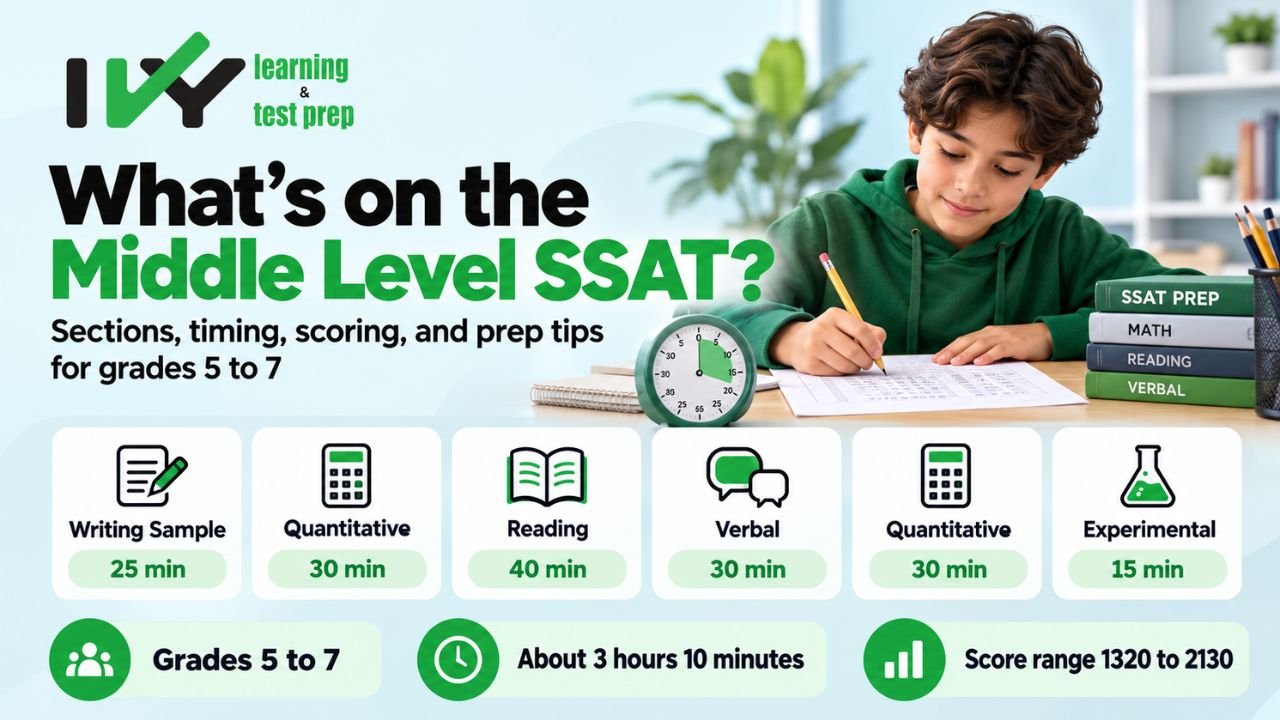
There are five multiple-choice sections and a Writing Sample in the Upper Level SSAT. In the scored sections, students’ Quantitative, Reading, and Verbal skills are tested. The test also has an Experimental section, which does not contribute to the total score.
Below, we’ve provided a quick overview of the Upper Level SSAT structure.
Section | Time | Num. of Questions |
Writing Sample | 25 minutes | 1 prompt |
Quantitative (Math) | 30 minutes | 25 |
Reading | 40 minutes | 40 |
Verbal | 30 minutes | 60 |
Quantitative (Math) | 30 minutes | 25 |
Experimental | 15 minutes | 16 |
You will also get two 10-minute breaks during the test. Don’t think the Writing Sample’s raw score is also included in your scored results.
The two Quantitative sections test the same general math skills. The Reading and Verbal sections focus on different areas. The next sections explain what you can expect from each part of the Upper Level SSAT.
What Is on the Upper Level SSAT Verbal Section?
You have 30 minutes to answer 60 questions, so knowing the question types before test day can help you use your time wisely.
In the upper-level SSAT verbal section, they test how well you understand words and the relationships between them. You have to answer 60 questions in 30 minutes. Therefore, you must know the question types before the test that help you approach prompts wisely in the allocated time.
You get to see two types of questions in this part:
- Synonyms: Choosing the answer that closely matches the given word.
- Analogies: You identify the relationship between two words and find the answer pair with the same relationship.
This means the verbal section mainly tests your vocabulary and ability to recognize word relationships. For preparation, building your vocabulary and practicing these question types can help you strengthen your skills.
What Is on the Upper Level SSAT Quantitative Section?
The Upper Level SSAT has two Quantitative parts. For both of them, you get 30 minutes to answer 25 questions. You have to solve problems accurately in the given time period.
Now you might be thinking about what kind of questions students encounter in it. It tests your math skills and assesses how you solve problems. This is something more than just recalling formulas. You can expect questions that require you to work with numbers, apply mathematical concepts, and choose the correct solutions.
Both Quantitative parts have the same format and timing and together contribute to your Quantitative score.
To become comfortable with this kind of question and timing, practice regularly. Focus more on understanding the concepts instead of relying on memorized formulas.
What Is on the Upper Level SSAT Reading Section?
On the Upper Level SSAT Reading section, you have 40 minutes to answer 40 questions. This is something interesting. First, you read several passages and answer questions based on the information and ideas presented in them.
The questions can ask you to identify the main idea, supporting details, meaning, purpose, or conclusions regarding the passage. Most probably, you may also need to make inferences and understand how information is presented.
This way, your ability to read and carefully choose the best answer is assessed.
What Is the Upper Level SSAT Writing Sample?
The Upper Level SSAT Writing Sample only has one prompt that needs to be completed in 25 minutes. This part of the SSAT is not considered in your total score. However, your response is sent to schools for review.
You should know that the test-taker receives 2 prompts and chooses one to answer. The choice is between a personal and a general essay prompt. You must write a response that clearly presents and develops your ideas. Don’t think that writing is not important just because it is unscored. Since schools read your answer, you must approach it directly and organize your writing clearly.
Understand the Experimental Section
The last section of the Upper Level SSAT is the Experimental section. Students have to answer the 16 questions in 15 minutes, but the raw score does not count toward the SSAT score.
Its questions can test your Verbal, Reading, and Quantitative skills. This section is particularly for test makers to evaluate questions for possible use on future SSAT test.
Therefore, you should still answer these questions with full focus, even though they do not affect your score.
How Is the Upper Level SSAT Scored?
Here is how the upper-level SSAT score:
Calculate the Raw Score
In every scored section, you earn 1 point for a correct answer and lose ¼ point for an incorrect answer. However, the unanswered question does not add or subtract points. As there are two Quantitative sections, both are considered when calculating the Quantitative raw score.
Convert the Raw Score to a Scaled Score
The points earned in each scored section are used to calculate a raw score. They are then converted into scaled SSAT scores from 500 to 800 for each scored section. The conversion can vary slightly between test versions because the difficulty of different forms may differ. SSAT uses statistical equating to account for these differences.
Calculate the Total Score
Since each section ranges from 500 to 800, the total score ranges from 1500 to 2400.
Determine the Percentile Rank
Students’ score reports also have a percentile rank from 1 to 99. It shows how individual students’ performance compares to other test-takers in the relevant SSAT comparison group.
Here is what percentile you can expect on different combined scores(they are approximate):
Upper Level SSAT Total Score | Approx. Percentile |
2400 | 99th |
2350 | 98th–99th |
2300 | 96th–98th |
2250 | 93rd–96th |
2200 | 88th–93rd |
2150 | 82nd–88th |
2100 | 75th–82nd |
2050 | 68th–75th |
2000 | 58th–68th |
1950 | 48th–58th |
1900 | 38th–48th |
1850 | 28th–38th |
1800 | 20th–28th |
1750 | 13th–20th |
1700 | 8th–13th |
1650 | 4th–8th |
1600 | 2nd–4th |
1550 | 1st–2nd |
1500 | 1st |
Tips to Prepare for the Upper Level SSAT
Here is how you can make a mark in the Upper Level SSAT and get admission to your dream school:
1. Understand the Test Format
First of all, even before SSAT preparation, understanding the SSAT structure is important. Get complete knowledge of sections, question types, timings, and order of the Upper Level SSAT. Knowing what to expect plays an integral role in practice and helps you become more comfortable with the test format.
2. Take a Practice Test
Before starting preparation, you must take an SSAT practice test to see where you currently stand. Don’t forget to also take advantage of the official SSAT free Mini-Practice. It will provide insights into where you are weak and what not to revise again and again.
3. Focus on Your Weak Areas
Review the questions you missed in previous trials and work on the underlying skill instead of just memorizing the correct answers.
4. Practice With Official Materials
The best part is that official SSAT practice materials are designed by the same team that develops the test. They usually include full-length practice tests, section tests, and topic quizzes.
5. Practice Under Test Conditions
Whenever you take full-length practice tests, set the time limits to the same as those allocated for the official test. Knowing how long is the ssat upper level test can also help you plan your practice sessions and manage your time effectively. This way, you become familiar with how to move between sections and answer questions within the given time.

Upper Level SSAT FAQs
Here are the answers to some of the most asked questions:
Can I Take the Upper Level SSAT More Than Once?
Yes, you can take the Upper-Level SSAT multiple times in one testing year. Its time period usually starts from Aug 1 to July 31.
Can I Send My SSAT Scores to Schools After Receiving Them?
Yes, obviously you can send your upper-Level SSAT to schools or educational consultants. You first have to log into the parent/guardian SSAT dashboard, then select which score should be sent. Usually, students select the score recipient at registration time, so they don’t have to manually do this lengthy procedure.
Can I Take the Upper Level SSAT Online?
Yes. Upper Level students can take the SSAT through computer-based options, including Prometric testing and SSAT at Home where available. The availability depends on location and testing requirements.
Can I Cancel or Reschedule My Upper Level SSAT?
Yes, it is possible to cancel or reschedule SSAT registration through your SSAT account. However, the deadlines and fees may apply depending on the testing method and when you make the change.
Can I Get Testing Accommodations for the Upper Level SSAT?
Yes. Students who qualify can request testing accommodations. The accommodation must generally be approved before registering for the test, and registration deadlines can vary by testing date.
Conclusion
The Upper Level SSAT may seem challenging at first, but knowing what to expect can make your preparation much easier. You now have a clear idea of the test structure, including the Verbal, Quantitative, Reading, Writing Sample, and Experimental sections. Start by understanding the question types and timing for each section. Then, use practice tests and official materials to find your weak areas and work on them.
Regular practice under test conditions can also help you manage your time and feel more comfortable on test day. Most importantly, focus on understanding the skills behind the questions rather than simply memorizing answers. With consistent practice and a clear preparation plan, you can approach the Upper Level SSAT with greater confidence and be better prepared for the test. Ivy Learning and Test Prep helps students prepare for the Upper Level SSAT with focused guidance, practice, and effective test strategies.