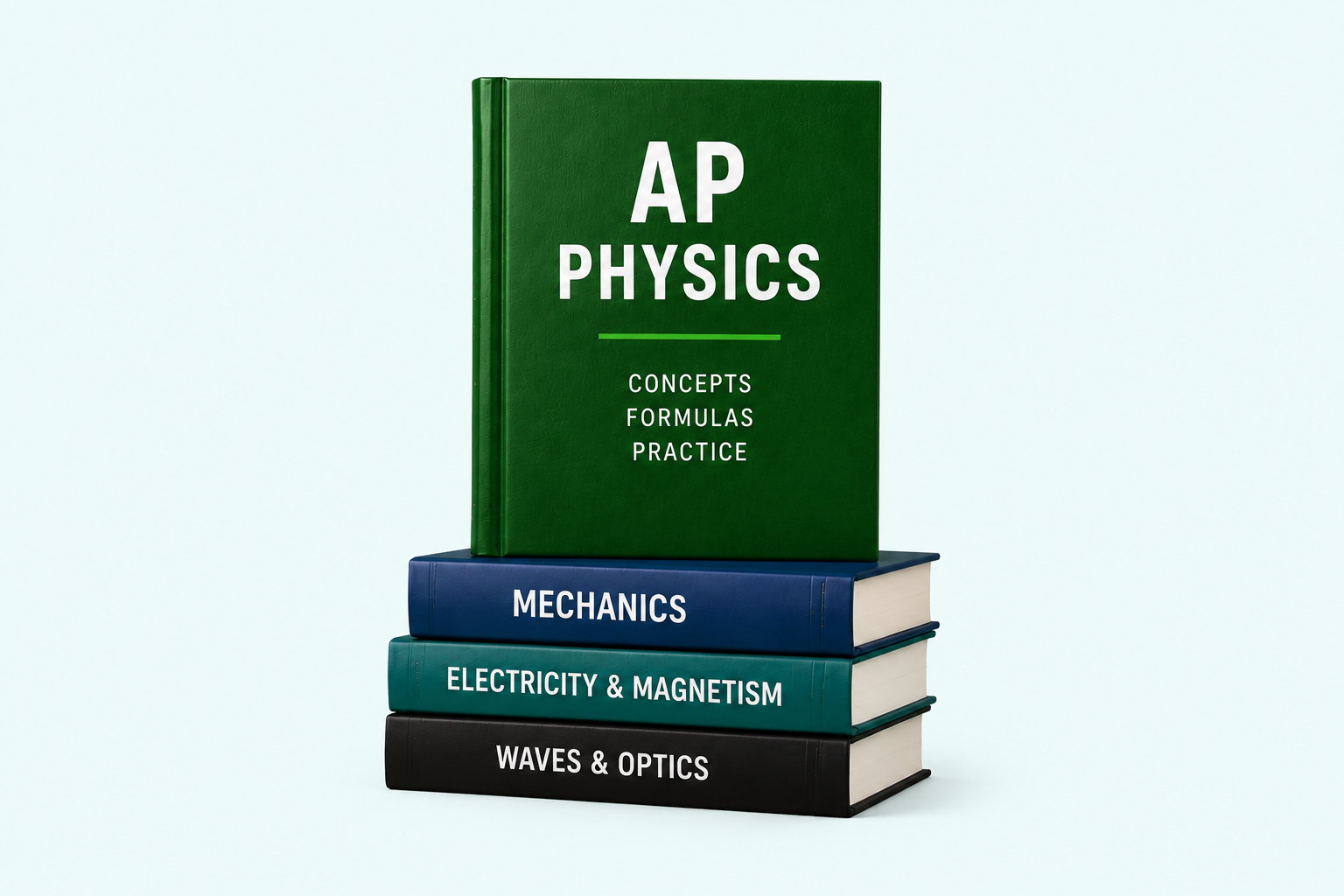
Only 50% of students get passing marks in the AP Physics exam. Due to high complexity, the percentage of students who achieve the highest score is 8. These statistics clearly demonstrate that it is a tough subject. Now, you might be wondering whether it is hard or if students just don’t opt for the right learning approach. To get the answers to all such questions, continue reading today’s complete student guide to AP Physics difficulty.
What is AP Physics?
AP Physics is a group of physics courses offered to high school students by the College Board. They mainly contain topics like motion, forces, energy, electricity, and magnetism. Students take part in them to analyze whether they should pursue this subject as their next career path. Participating in these courses helps them to build a solid foundation for further studies in science, engineering, and other STEM fields.
Understanding the Different AP Physics Courses
AP Physics difficulty can be determined by understanding its structure and different course levels. It is not a single course. AP physics is divided into four main versions that differ in difficulty, content, and mathematical concepts. Students are allowed to select among them or choose all of them.
AP Physics 1: Algebra-Based (The Most Failed AP Exam)
It is considered the introductory college-level physics course, which covers core topics, such as:
- Motion (kinematics)
- Forces and Newton’s laws
- Work, energy, and power
- Momentum and collisions
- Rotational motion
- Waves and simple circuits
What Makes AP Physics 1 Hard?
The challenge is that students need to grab proper conceptual understanding, instead of turning to a memorization shortcut. That means they are expected to analyze, handle, and solve unfamiliar situations smartly. The questions usually need deep thinking, and the detailed answers to clearly show your understanding under time pressure. Due to this reason, the AP Physics 1 exam has a lower pass rate. We can say AP Physics 1 feels difficult because it asks for students’ conceptual understanding rather than rote learning.
AP Physics 2: Algebra-Based (Continuation Topics)
The next level is AP Physics 2, which is also based on algebra. It is not necessary to pass AP Physics 1 to pursue this one.
Wondering about the difference?
This course needs the same skills. However, it deals with more abstract areas of physics compared to the first one.
Example
AP Physics 1 focuses on motion and forces, while AP Physics 2 shows how these concepts apply to real-world situations.
AP Physics 2 typically includes the topics:
- Fluid mechanics
- Thermodynamics (heat and energy transfer)
- Electricity and magnetism (deeper level than AP Physics 1)
- Waves and sound
- Optics (light and lenses)
- Modern physics basics (atomic and nuclear concepts)
What Makes AP Physics 2 Hard?
The topics do not make it tough, but the way students connect multiple concepts and apply them in unknown scenarios. The problems are not direct and clear. Students have to specifically focus on providing genuine reasons and solutions using their own skills.
AP Physics C: Calculus-Based
It is the advanced course in which you go through the essential details of mechanics. Since it is calculus-based, students use calculus concepts such as derivatives and integrals to evaluate physics problems. This AP Physics explores the fundamentals of motion and forces, but at a much deeper level.
The most common topics we get to see in AP Physics C Mechanics are:
- Kinematics (motion in one and two dimensions)
- Newton’s laws of motion
- Work, energy, and power
- Systems of particles
- Rotational motion
- Gravitation
What Makes AP Physics C Mechanics Hard?
At this level, students do not just need strong concepts. The depth of mathematics in this exam requires them to use calculus to derive relationships and solve problems accurately. It means the students who plan to take engineering, physics, or other STEM fields take part in this course. It helps them identify where they stand in the advanced science and mathematics landscape.
AP Physics C Electricity and Magnetism: Calculus-Based
This one is next in the series and is considered the most advanced physics course offered in high school. This subject is all about the field of electricity and magnetism and how they interact. It does not include the basic foundations. Applicants learn how electric charges and currents create forces and fields. And how electric devices and motors are made using these fields. Its concepts are usually similar to second-semester physics.
Let’s know below what the major topics are in AP Physics C Electricity and Magnetism:
- Electric fields and forces
- Electric potential and capacitance
- Electric circuits (including Kirchhoff’s laws)
- Magnetic fields and forces
- Electromagnetic induction
- Maxwell’s concepts (intro level)
Why is AP Physics C Electricity and Magnetism Difficult?
The real challenge in this course is that physics and advanced mathematics are combined. Both are tough subjects, so the answers are long and require multiple steps to explain. Often, participants have to decide which concepts and formulas are needed to use in a certain situation.
This course is based on university-level study. If your math or physics is weak, it can feel super difficult. AP Physics C Electricity and Magnetism is usually taken by students who want to study engineering, physics, or other technical subjects.
Key Challenges in AP Physics
The simple reason behind the difficulty of AP Physics is that students need to show their genuine understanding. Rote systems cannot work out. Students need to learn deeply how and why physical processes work. It is for encountering situations that they have not seen before.
Let’s study the factors that contribute to its difficulty:
Conceptual Mastery
The most common factor that is common in all variants is that you have to grab concepts. AP Physics cannot be passed by just remembering formulas. You should have a proper understanding of why a certain formula applies at a specific place. That is only possible when you know how it performs in different situations. For such expertise, understanding physical principles and how they relate to each other is important.
Multi-Step Problem-Solving Requirements
AP Physics questions are not simple and direct. Students need to have strong logical thinking and careful problem-solving to succeed. That’s because the answers contain proper reasons, explained in steps, and flow accurately. This demonstrates that formulas are not enough to resolve a situation. Students should have knowledge of when and how to use them at the right time.
High Standards of Assessment
AP Physics follows the assessment standards set by the College Board. Applicants must have full knowledge of the concept applications to answer college-level questions effectively. Many students and tutors share that the paper content sometimes feels confusing, even after multiple-choice questions. It becomes harder for students to match the situation with what they have studied in a short time period.
Mathematical Reasoning and Application
In the AP Physics course, physics and mathematics interconnect. It becomes impossible to understand most of the physics concepts without mathematics. Therefore, practice is important to choose the right equations, apply them, and produce the correct answers during exams. Most of the questions test the strength of students’ conceptual understanding in different unseen scenarios.
How to Succeed in AP Physics: Proven Strategies
If you’re wondering how to prepare for AP classes, AP Physics is one of the best examples where preparation requires more than memorization and focuses on deep conceptual understanding. Here are some key tips that ensure success in AP Physics:
Study Techniques That Actually Work
It’s better to dedicate more time to learning the depth of topics. After understanding the concepts, practice applying them to different types of problems. This can help you to face situations that you have not even dealt with before. For this purpose, it’s important that you regularly:
Solving new problems
Checking mistakes
Strengthening concepts
Improving weak areas
With the help of good understanding and practice, you can be more confident in the course.
Approach Practice Problems
If you misunderstand anything in an exam, like a question, the correct answer can never be extracted. That’s what the most important concern is. You should first analyze what the question asks instead of just starting to solve. All problems should be approached with an accurate method after identifying the concept being tested. Don’t rush in selecting the correct equation and principle that actually needs to be applied. If you are unsure about something, you can tweak it to get it. But avoid solving it quickly. Once you are sure about the reasoning, it becomes easy to match the physical situation with the correct answer. It won’t be wrong to say that your exam accuracy and speed depend on how much you have invested in practice.
Using the Equation Sheet Effectively
Students are provided with the equation sheet, so they don’t have to memorize formulas. Although it does not ensure success, the key lies in how you use it efficiently. During practice, it is important to identify where different equations are located. This way, they can be used quickly and confidently in the AP Physics test.
Time Management for the Exam
Managing time is important because the AP Physics exam consists of multiple questions. That needs to be completed in a fixed time. Therefore, you should not spend much on a single query. Move on if feeling stuck somewhere for a long period. In the practice phase, working under a fixed time increases students’ speed.
Resources and Tools for AP Physics Preparation
Using the right resources during preparation makes it easier to pass AP Physics. Regarding this, valuable materials include official College Board course descriptions, and past papers are helpful. Students can also benefit from structured programs like Ivy Learning that focus on AP exam preparation and guided practice. That reflects the exam format and level of difficulty you have to prepare for. Moreover, textbooks and review guides are useful for building the topic’s important concepts. Online videos, physics class, and practice websites allow you to learn everything thoroughly and comprehensively. All of this contributes to improving your problem-solving skills and AP test readiness.
Frequently Asked Questions About AP Physics Difficulty
Here are the commonly asked questions about AP Physics that we get to hear from our students.
Is AP Physics 1 the hardest AP class?
No. AP Physics 1 is not the hardest AP class among all, including AP Biology, AP Science, and AP Chemistry. Although it is challenging, it is not one of the hardest ones. Students find it conceptual and confusing.
Can I take AP Physics without prior physics experience?
Yes. You can go for AP Physics 1 without prior physics experience because it is an introductory-level AP course. That typically includes only the basics, making it easier for students to pass with conceptual understanding and strong math.
Is AP Physics harder than regular high school physics?
Yes, AP Physics is harder than regular high school physics. It requires strong concepts and problem-solving skills to deal with the unfamiliar questions.
How many hours should I study for AP Physics?
You should study at least 60 to 120 hours during the entire course. However, the exact time depends on your background, learning style, aptitude, and target score.
What score do I need for college credit?
Many colleges accept a score of 4 or 5 for credit, while others also consider 3 or higher. It depends on their policy, which means it varies by the university and program.
Final Thoughts on AP Physics
Each AP Physics course is of a different difficulty level based on the student’s academic goals. Choosing AP Physics 1 can be a good decision for basic understanding. AP Physics 2 consists of a bit more advanced topics compared to AP Physics 1. You can pursue it as well, depending on your aptitude. The most upper-level courses are in AP Physics C. They are designed for students who really want to take part in STEM fields at the university level. Now, you may be thinking of selecting a course. If so, ask yourself, “Do you want to pursue such fields for your academic future?