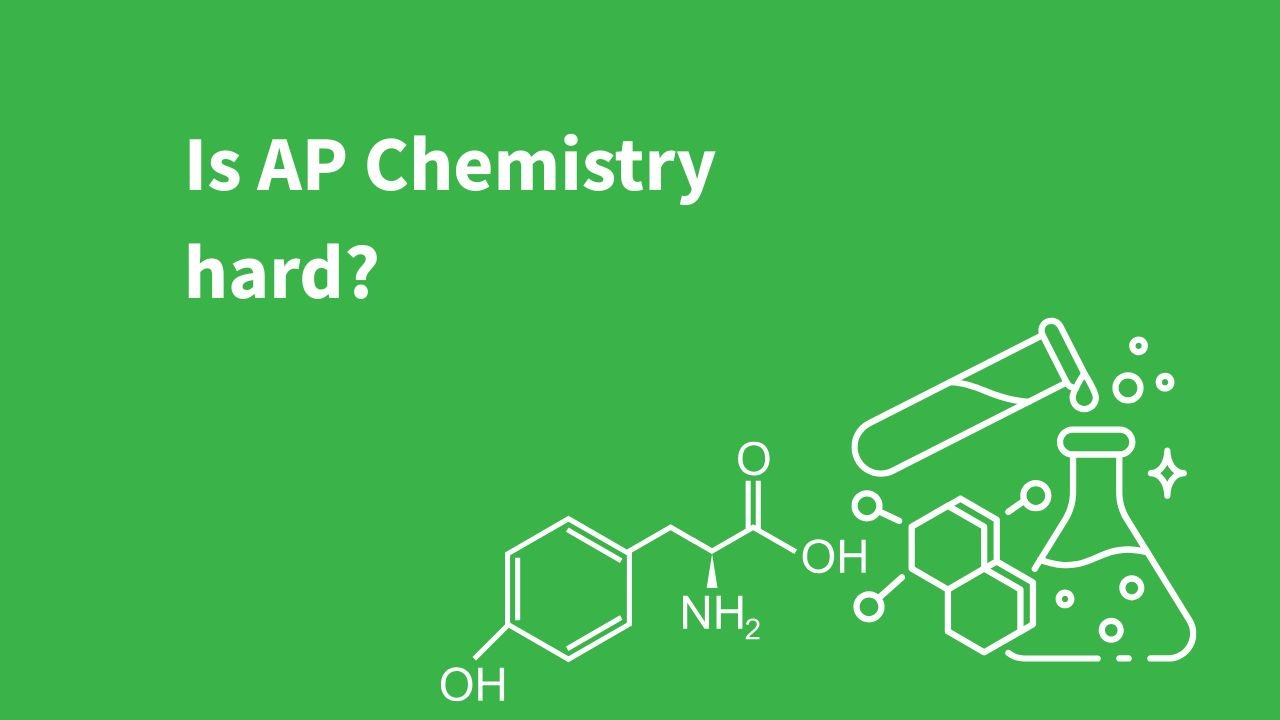
AP Chemistry, a scary subject for students, is offered by the College Board. The students who want to experience college-level chemistry in high school usually take part in it. They often asked whether chemistry is really hard or if it’s just the rumors. We will conclude it by examining the course content, workload, and the skills students need to succeed. So, if you are thinking of taking AP Chemistry, read this article till the end; it must be helpful.
What is Included in AP Chemistry?
Students cannot succeed in the AP Chemistry exam by relying solely on a rote technique or last-minute preparation. It’s because this course is mainly designed to help students understand the chemical processes. That means the syllabus consists of concept-based topics, which are:
- Atomic Structure and Properties
- Molecular and Ionic Compound Structure and Properties
- Intermolecular Forces and Properties
- Chemical Reactions
- Kinetics
- Thermodynamics
- Equilibrium
- Acids and Bases
- Applications of Thermodynamics
Students analyze reactions, interpret laboratory results, solve multi-step numerical problems, and connect different chemistry concepts. Laboratory investigations help to improve observation, analytical thinking, and data interpretation skills. Another important part of AP Chemistry is that students also use mathematical formulas, graphs, experimental calculations, and scientific reasoning. It is to solve problems in different situations.
What Makes AP Chemistry Hard?
Multiple factors make AP Chemistry challenging for learners and contribute to the lower AP Chem pass rate compared to many other AP subjects. They are discussed below:
Conceptual Understanding Instead of Memorization
The first and most important reason behind its difficulty is that you do not only need to memorize definitions. But also understand how chemical reactions occur, how particles behave, and why different chemistry concepts relate together. It’s because the questions are answered by proper interpretation, reasoning, and explanation. That means weak concepts can lead to ineffective performance in exams.
Topics Build on Each Other
The chemistry scenarios are connected to each other. Each topic contributes to building the foundation for the next ones. For instance, atomic structure, stoichiometry, and bonding prepare you for advanced units like acids and bases, equilibrium, and thermodynamics. Hence, if you start confusing in the first chapters, it may continue throughout the course. At the start, students consider it a manageable subject, but later on, they experience difficulty when advanced topics begin.
Math-intensive Increases the Complexity
AP Chemistry also requires Algebra II skills that add further difficulty. The multi-step questions need to be simplified by analyzing graphs, interpreting data, using logarithms, and applying formulas. Approximately 35%–53% of the AP Chem exam involves mathematical calculations. So, the students who understand chemistry sometimes feel stuck in numerical problems. These problems are solved using scientific reasoning and mathematical accuracy simultaneously.
The Course Pace Feels Fast for Many Students
A wide number of topics have a lot of content that students have to cover in one year. You may feel that the chapters are introduced quickly, and homework includes assignments, laboratory reports, and exam preparation. This all may feel challenging. If you do not cover daily work, you may struggle in the last months. It showcases that consistency becomes important in the AP Chemistry course.
Student Experience Can Be Different
Your AP chemistry experience depends on your previous chemistry knowledge, mathematical background, and study habits. Students with strong algebra skills and regular practice habits can adjust to the course structure smoothly. Many students have claimed that it becomes manageable when they focus more on in-depth concepts and reasoning.
How Hard Is AP Chemistry Compared to Other AP Sciences?
We can better understand AP Chemistry’s hardness by comparing it with other science subjects.
AP Science Subject | Math Level | Memorization Load | Concept Complexity | Lab/Analysis Demand | Overall Difficulty (Relative) |
AP Chemistry | High | Medium | High | High | High |
AP Biology | Low–Medium | High | Medium | Medium | Medium |
AP Physics | Very High | Low | High | Medium | High |
AP Environmental Science | Low | Medium | Low–Medium | Low–Medium | Lower |
Understanding the Structure of the AP Chemistry Exam
The AP Chemistry exam’s main aim is to test students’ concepts. For this purpose, students are placed in completely unfamiliar situations. Your problem-solving skills, reasoning knowledge, and the ability to relate ideas can help you deal with such scenarios effectively.
Let’s get an idea of the AP Chem exam structure to know how you are expected to use your skills. It consists of two major parts, which are:
Multiple-Choice Section
The first section comprises multiple-choice questions that test your conceptual understanding, mathematical skills, and analytical abilities. Most of them are based on real-world or experimental contexts. Their correct answer needs to be identified by interpreting data, analyzing graphs, or applying chemical principles. This highlights the importance of conceptual understanding and meaningful reasoning to complete this part.
Free-Response Section
The free-response questions (FRQs) section is the other part that asks for detailed explanations of answers. The questions are usually solved step-by-step in this part. Meaning, you may expect to perform experiments, interpret laboratory results, or explain chemical processes. Your practice should be good enough to provide clear reasoning and structured answers to these questions.
How to Manage AP Chemistry?
AP Chemistry is a tough subject, but it is not impossible. You can manage it easily and secure an even higher score by adopting a few habits. Understanding how to prepare for AP classes early on can make this process much easier. The following are some of the habits that may prove helpful:
Stay Consistent with Daily Study
As we discussed earlier, it is a concept-based course that has a massive syllabus. If you consistently learn, understand, and practice assigned work, you can easily build conceptual clarity throughout the course. This also prevents topics from accumulating.
Focus on Conceptual Understanding
Its exam structure indicates that memorizing reactions or formulas simply does not earn a better score. Your grasp of how and why chemical processes occur should be strong. With a clear understanding, you can confidently approach unfamiliar problems and get the desired score. And concepts can only be learned through regular practice and relating chemistry study to everyday life scenarios.
Practice With Exam-Style Questions and Past Papers
After taking regular AP classes, you should set a specific time to practice past papers and exam-like questions. It is the most effective way to practice whatever you have learned in class. This helps to show how equations are applied and what level of thinking is expected in real exam questions. Attempting such questions during the learning phase significantly increases your accuracy, speed, and confidence.
Time Management
You should set a fixed time for your lectures, assignments, lab work, and revision. Following the same routine daily not only makes you consistent but also aligns tasks within a specific time period. Such habits prove useful to wrap up the curriculum in a year and improve efficiency during the exam.
Learn from Mistakes
The most important strategy to make AP Chemistry manageable is to learn from your mistakes. Don’t ignore when your answers are marked wrong. Instead, always find out what you did and why it happened. When you start working on your weak area and try to reduce the mistakes, the chances of repeating them decrease. This way, you can avoid making these mistakes in the exam.

AP Chemistry FAQs
Below are the answers to questions our students often ask about:
Is AP Chemistry worth taking?
Yes, AP Chemistry is worthwhile, especially if you are planning a career in science. It teaches the basics of science and assists in achieving college credit with a score of 3 or higher.
How can I stay confident during the course?
You feel confident naturally when you keep progressing. At the start, it takes time to manage everything. So, you should be consistent and try to improve management gradually.
What is the best way to prepare for the exam at the end?
My recommendation is that you should not collect the syllabus for last month. It results in a weak concept that can lower effectiveness in the exam. To get a passing score, it’s important to revise and solve exam-type questions throughout the course.
Can I do well even if I find some topics difficult at first?
Yes, many students have claimed that AP Chemistry feels challenging at the start. With consistency, practice, and routine work, they become confident in it over time.
Final Verdict
This article summarizes that AP Chemistry is a hard course, but not impossible to pass. Its concept-based topics and algebra equations make it difficult for most students. If they follow the right strategies, it becomes easy for them to earn the expected AP scores. The factors that can help to achieve success are regular practice, conceptual understanding, and skills in solving mathematical problems.
Students tend to take AP Chemistry to strengthen their foundation for advanced college-level topics. So, if you want to pursue science, engineering, or STEM subjects, AP Chemistry can be an ideal choice. It can improve your basic chemistry concepts, problem-solving skills, and laboratory expertise. Students looking for expert AP exam prep, personalized guidance, and academic support can also explore programs offered by Ivy Learning & Test Prep.