The SSAT quantitative section emphasizes speed, accuracy, and analysis skills. It focuses more on mathematical reasoning and problem-solving than on memorization. A student who understands the math can still lose points to the clock or to careless guesses. Students must apply familiar concepts to different question types, including geometric calculations, equations, numerical patterns, and word problems.
For Middle and Upper Level SSAT candidates, the Quantitative section consists of two separate sections:
| Test component | Format |
|---|---|
| Number of sections | 2 |
| Questions per section | 25 |
| Total questions | 50 |
| Time per section | 30 minutes |
| Total math testing time | 60 minutes |
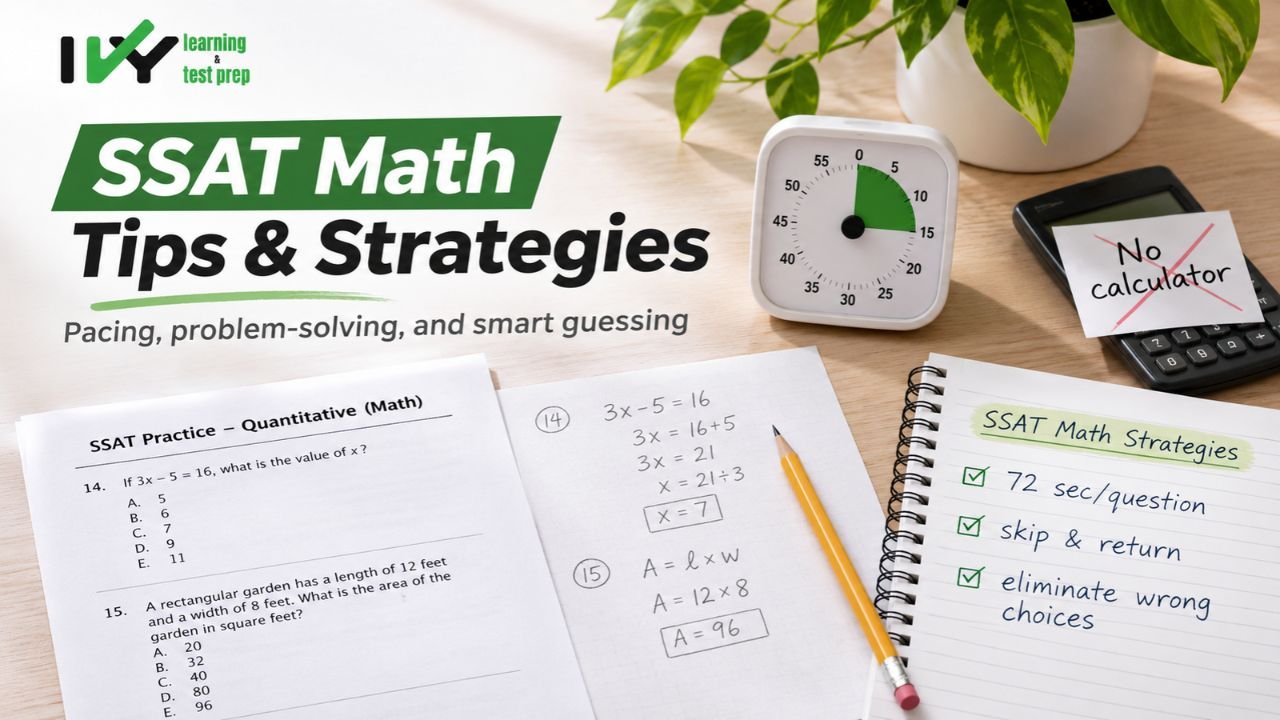
| Average time per question | 72 seconds |
Both sections count toward your overall quantitative score. The two math sections are separated by the reading and verbal sections, so students need to keep their concentration throughout the exam.
How Is the SSAT Math Section Structured?
The format changes by level:
| Level | Math sections | Questions | Time | Wrong-answer penalty |
|---|---|---|---|---|
| Elementary (grades 3–4) | 1 | 30 | 30 minutes | None |
| Middle (grades 5–7) | 2 | 25 each | 30 minutes each | −¼ point |
| Upper (grades 8–11) | 2 | 25 each | 30 minutes each | −¼ point |
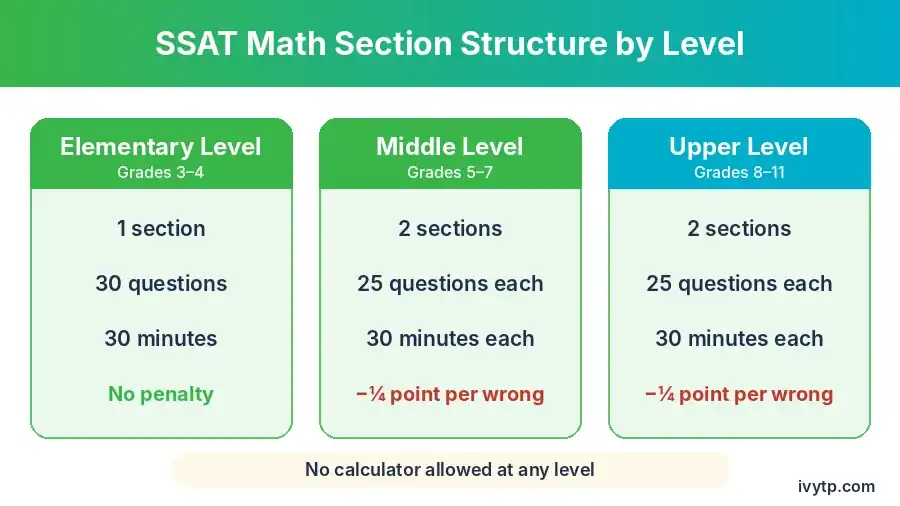
No level allows a calculator. Middle and Upper Level students answer 50 math questions in total, with the reading and verbal sections between the two math sections. For a full breakdown of every section, see what is on the SSAT.
SSAT Math Tips and Strategies to Improve Your Performance
Pace Each Question at About 72 Seconds
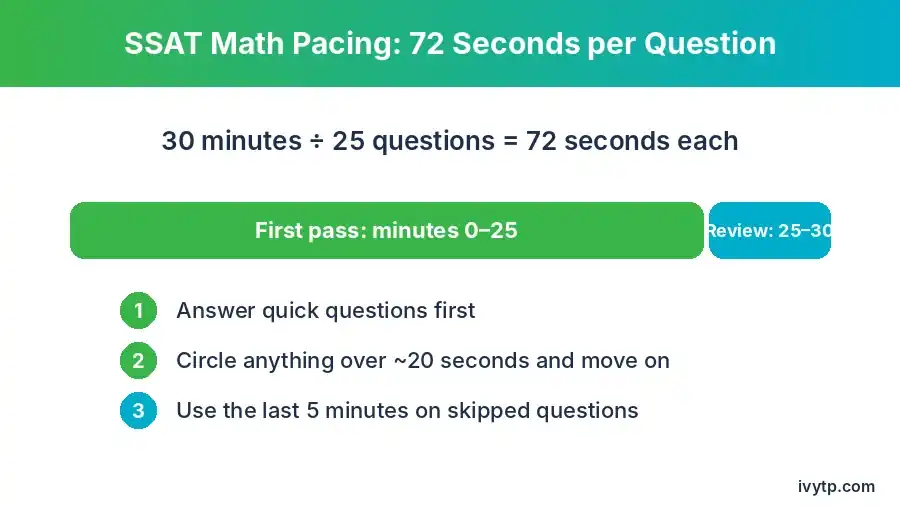
Don’t spend too long on a question when you are stuck. Time is limited: 30 minutes divided by 25 questions gives you 72 seconds per question. Solve the easy questions that take little time first, and spend the remaining time on the hard ones. Aim to finish your first pass in 25 minutes and use the last five minutes to review the questions you skipped.
Skip First, Return Later
As you work through the section, mark any question that looks like it will take more than 20 seconds and move on to the next one you can solve. Every question is worth the same point, so a hard question at number 8 counts no more than an easy one at number 20. Circle skipped questions in the test booklet so you can find them fast.
Guess With Math, Not Hope
Careless guesses hurt on the SSAT quantitative section. At the Middle and Upper Levels, you get one point per correct answer, lose a quarter point per wrong answer, and get zero for a blank. Each question has five choices. Here is the expected gain from a guess under this guessing penalty:
| Choices eliminated | Chance of a correct guess | Expected points |
|---|---|---|
| 0 | 20% | 0.00 |
| 1 | 25% | +0.06 |
| 2 | 33% | +0.17 |
A blind guess breaks even. Eliminating one choice turns the guess profitable. Guess when you can cross out at least one answer, and leave the rest blank. The Elementary Level has no penalty, so answer every question. Our guide to common SSAT mistakes covers more test-day errors to avoid.
Pick Numbers for Variable Problems
When a question uses variables, or percents with no starting value, pick numbers and replace them with easy values. For example:
The price of a dress falls 20%. The sale price then drops 25%. The final price equals what percent of the original?
Start with $100. After 20% off, the price is $80. After 25% off, it is $60. The answer is 60%. Adding the discounts to get 45% and subtracting from 100 gives 55%, which is the trap answer.
Back-Solve From the Answer Choices
SSAT answer choices appear in order, so when you back-solve, start with the middle one.
Sara has 3 times as many stickers as Tom. Together they have 48. How many does Sara have? (A) 12 (B) 24 (C) 30 (D) 36 (E) 40
Test (D) 36. Tom would have 12, and 36 + 12 equals 48. The answer is (D). One test replaced a full equation.
Build Mental Math Fluency
The SSAT doesn’t allow a calculator, so your arithmetic speed decides how much time is left for the hard problems. Drill these for ten minutes a day to build mental math fluency:
- Multiplication facts through 12 × 12
- Fraction, decimal, and percent equivalents (⅛ = 0.125 = 12.5%)
- Squares through 15²
- Round-and-adjust: 49 × 6 becomes 50 × 6 − 6 = 294
Write Every Step on Scratch Paper
Write out your work for every practice problem. A written trail lets you find an error in seconds instead of redoing the whole problem. Students who solve in their heads and miss the answer have nothing to check. Write one step per line on your scratch paper.
Read the Last Sentence Twice
Many wrong answers come from solving a different question than the one asked. Underline the target before you calculate, and watch for these words:
- NOT, EXCEPT, LEAST: the question asks for the odd one out.
- Units: the question asks for minutes, but your answer is in hours.
- Area vs. perimeter: read the shape word, then the measure word.
Keep an Error Log
After each practice set, record every miss in an error log with three columns: topic, cause, and fix. The cause falls into one of three types: concept gap, careless slip, or time pressure. Patterns appear within two weeks. A student who misses fraction questions again and again knows what to study next.
What Math Topics Does the SSAT Test?
The SSAT math section covers arithmetic, algebra, and geometry. Expect number sense, fractions, decimals, percents, ratios, basic equations, area, angles, and multi-step word problems. Upper Level SSAT questions tend to be harder, with more algebra and reasoning than the Middle Level SSAT. Check each school’s published score expectations for your target program, and see what a good SSAT score is for private school admission.
How Should Students Prepare Each Week?
- Three days: 20 minutes of mixed practice, untimed, with full written work.
- One day: a timed 25-question section.
- One day: error log review and a redo of every missed question.
- Daily: 10 minutes of mental math drills.
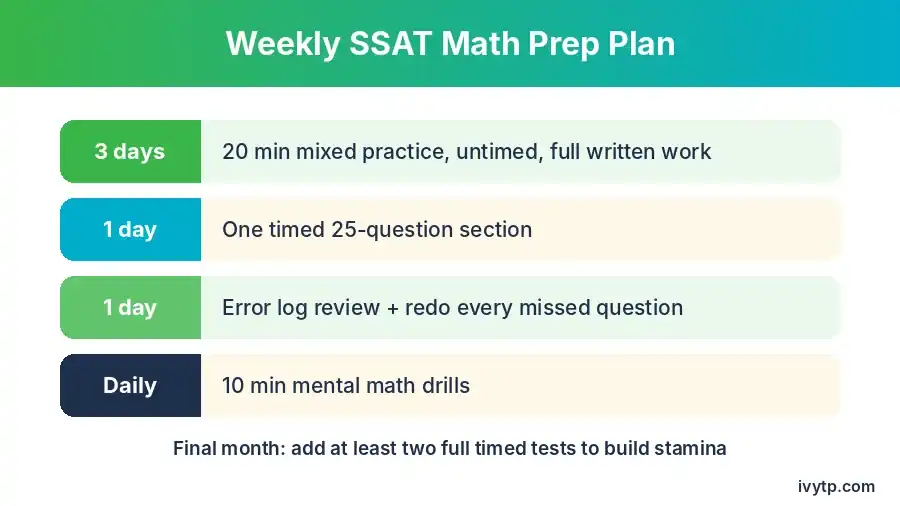
The test is long, and mental fatigue builds up, so work on stamina in the month before test day. Taking a full-length SSAT practice test in test-like conditions helps build endurance. Middle and Upper Level students sit two math sections, and even with good prep, fatigue lowers accuracy in the second one, so take at least two full timed tests. Official practice materials are on the SSAT website, and our tips on balancing school work with SSAT prep help you fit this plan into a busy week.
SSAT Math FAQs
Commonly asked questions about SSAT math quantitative section prep.
Does the SSAT allow a calculator?
No. The SSAT doesn’t allow calculators at any level.
Should I guess on SSAT math questions?
On the Middle and Upper Levels, guess only when you can eliminate at least one wrong choice. On the Elementary Level, answer every question.
How many math questions are on the SSAT?
Elementary students answer 30. Middle and Upper Level students answer 50, split across two sections.
How long should I spend on each question?
About 72 seconds on average. Spend less on easy questions and save that time for the harder ones.
Bottom Line
The SSAT math section can be a challenge for most students, and how hard the SSAT feels often comes down to pacing and careless errors. Ivy TP’s experienced tutors build SSAT prep plans around your child’s error log, timing, and target schools. Book a diagnostic with Ivy TP to see where your child loses points.